
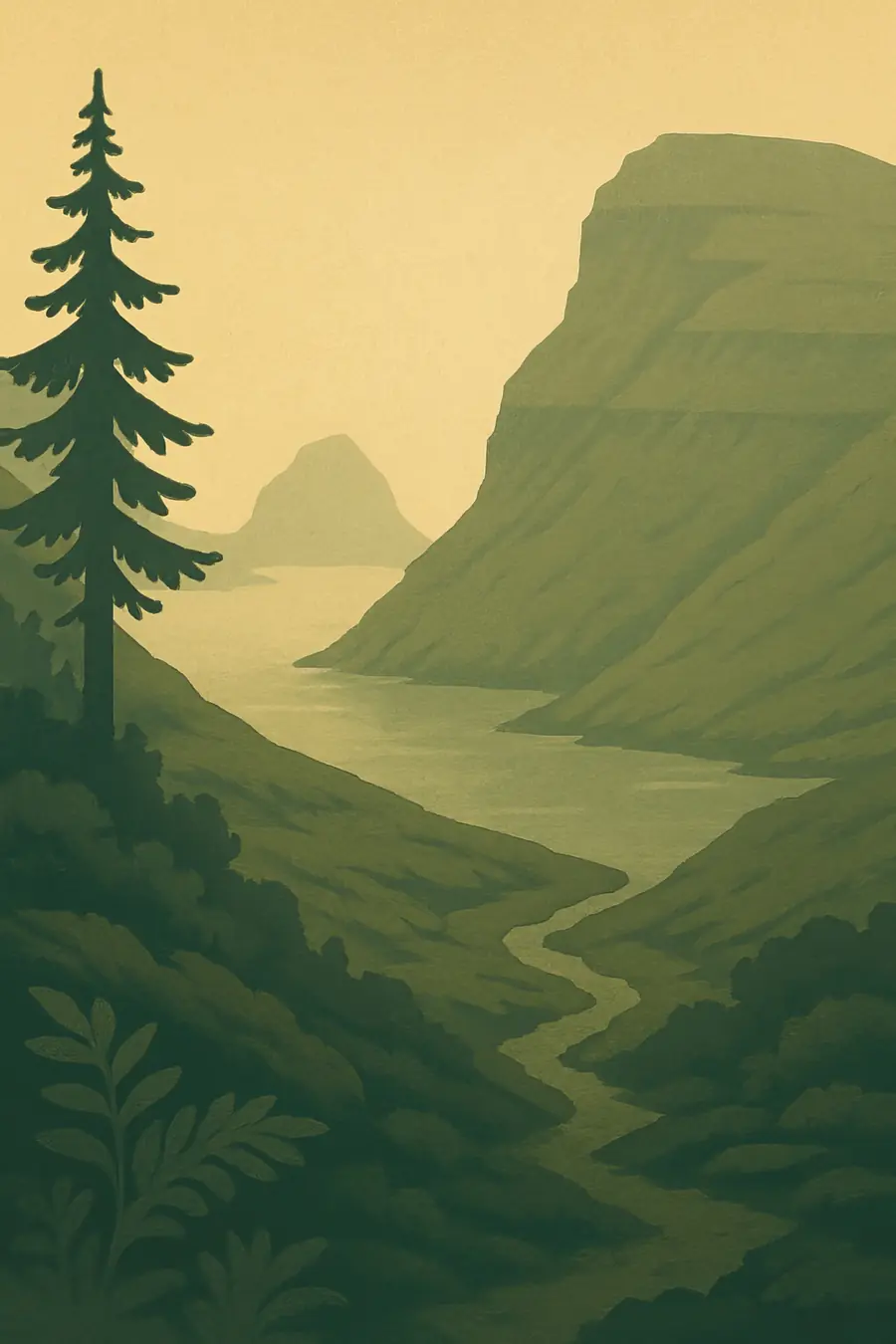
The place
The islands are built from stacked basalt lava flows that erupted when the North Atlantic began to open, around 60 to 55 million years ago. Ice and the sea have since cut them into steep green slopes, deep fjords and sea cliffs hundreds of metres high. The highest peak, Slættaratindur, rises to 882 m. The climate is cool and oceanic, warmed by the North Atlantic Current: winters are mild for the latitude, summers are short and cool, and weather changes fast between fog, rain, wind and sunlight. There are almost no native trees. You hear wind, waterfalls, sheep and the cries of seabirds along the cliffs.
History
Irish monks may have reached the islands before the Norse, but the first lasting settlement came from Norse farmers in the 9th century, as told in the Færeyinga saga. Their assembly at Tinganes in Tórshavn is one of the oldest in Europe. The islands came under Norway and later Denmark, and for long periods trade was a Danish monopoly. Islanders lived from sheep, small fields, fishing and seabird fowling, catching birds with nets on long poles from the cliffs. In the 19th and 20th centuries, deep-sea fishing transformed the economy. Britain occupied the islands during the Second World War, and home rule was granted in 1948.
Why it matters for the living world
The Faroes are a major breeding area for North Atlantic seabirds, including puffins, fulmars, guillemots, kittiwakes, gannets on Mykines and very large numbers of storm petrels on Nólsoy. The surrounding shelf waters are rich in plankton, sandeels and fish, which support whales, seals and the islands' fisheries. The treeless grasslands, mires and moss heaths hold Arctic and boreal plants. Ocean warming is reducing sandeel numbers, and with them food for many seabirds. Faroese records show that about 200,000 puffins were caught in 1900, 95,000 in 2000, and only a few hundred today, a sign of how far the birds have declined.
People of the place
About 55,000 people live on the islands, speaking Faroese, a language descended from Old Norse. Fishing and salmon farming are the backbone of the economy, and land use is still organised partly around old village outfields shared for sheep grazing. Seabird fowling is a living tradition on islands such as Mykines, Skúvoy and Fugloy, though its future is uncertain as bird numbers fall and those communities age. The grindadráp, a community hunt of long-finned pilot whales driven into bays, remains part of Faroese food culture and draws strong criticism abroad. Faroese researchers are now documenting what these changes mean for local culture and identity.
What it faces
Warming seas and shifts in the food web are the main threat to seabirds, with falling breeding success for puffins, kittiwakes and others. Salmon aquaculture in the fjords brings sea lice, nutrient loading and escaped fish. Overgrazing by sheep limits the recovery of vegetation and soils. Tourism has grown quickly, and some popular paths and cliff sites have been closed or given access fees; the islands have also run volunteer maintenance weekends to repair trails. The 2021 killing of more than 1,400 white-sided dolphins in one hunt led to a review of quotas and wide public debate. Seabird hunting is now managed through local catch limits.
Sources
- Bird hunting in the Faroe Islands under threat from rising sea temperatures – NordForsk
- Faroes ecoregion – Seabirds – ICES
- Seabird productivity on the Faroe Islands – Nordic Council of Ministers
Written for Regenerative Voices from the sources above. Spotted something wrong? Tell us.