
The place
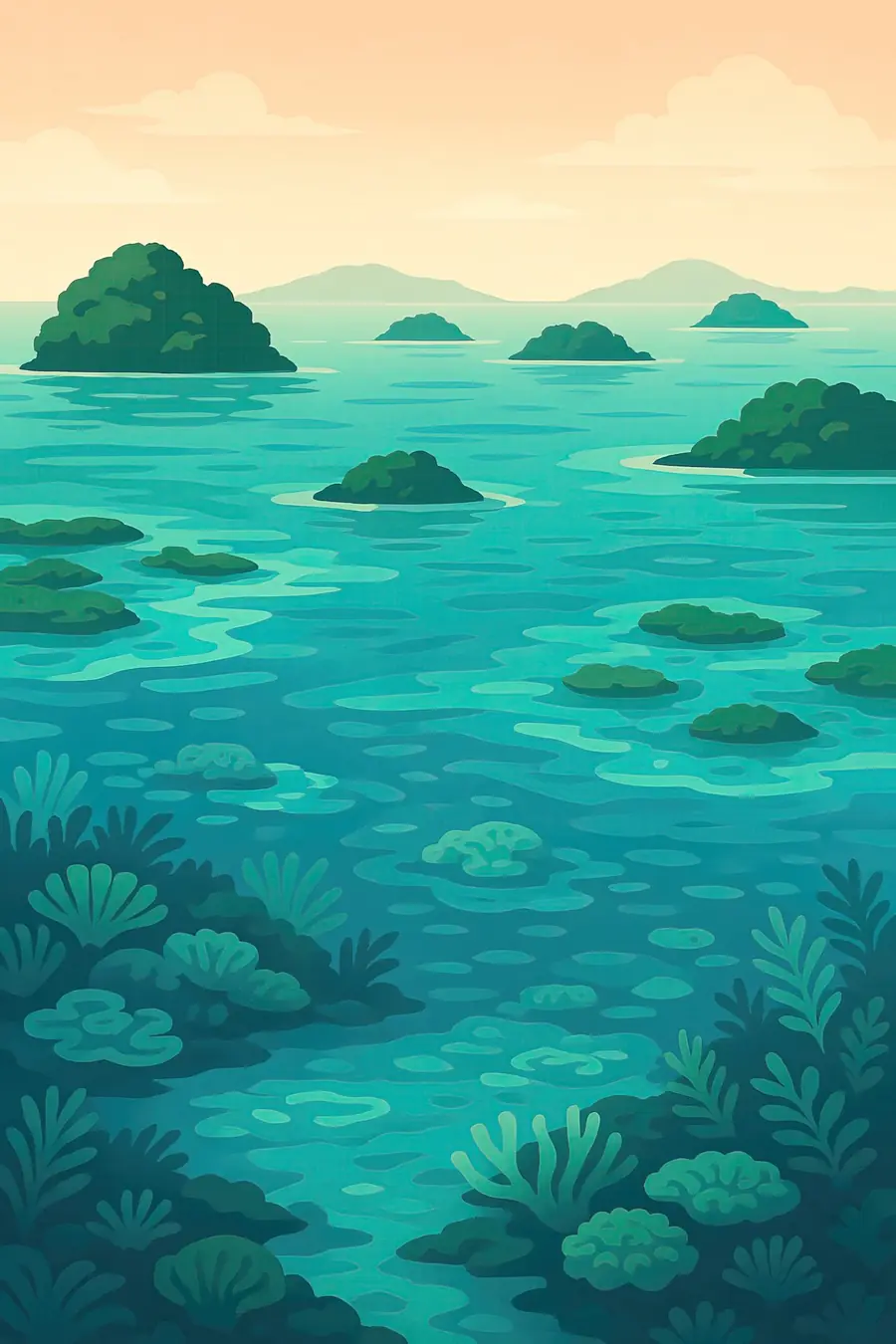
The reef is made of around 3,000 individual reefs and hundreds of islands and cays, scattered across the continental shelf of the Coral Sea. Corals, tiny animals that build skeletons of limestone, have grown here over hundreds of thousands of years, and the present reef began forming on the shelf after sea levels rose at the end of the last ice age. You see bright shallow lagoons, coral gardens, sandy cays, mangrove islands and dark channels, from the inner reef near the coast to the outer ribbon reefs at the shelf edge. The climate is tropical, with a hot, wet season and cyclones in summer.
History
Aboriginal and Torres Strait Islander peoples have lived along this coast and among its islands for many thousands of years, and their stories recall a time when the shelf was dry land before the sea rose. They fished, hunted turtle and dugong, and managed Sea Country through law and custom. In 1770, James Cook's ship Endeavour ran aground on the reef. Colonisation brought dispossession, violence and missions, and later, fishing, pearling and plans for oil drilling and limestone mining on the reef. Public campaigns in the 1960s and 1970s led to the Marine Park in 1975 and World Heritage listing in 1981.
Why it matters for the living world
The reef supports a large share of the world's coral reef biodiversity: hundreds of hard coral species, more than 1,500 species of fish, sharks, rays, dugongs, whales and six of the world's seven species of marine turtle. Its seagrass meadows and mangroves are nurseries for fish and store carbon. Seabirds nest on the islands, and green turtles breed in large numbers on Raine Island. Long-term monitoring by the Australian Institute of Marine Science shows that hard coral cover swings sharply with heat, cyclones and crown-of-thorns starfish outbreaks. In 2024 to 2025, two of three regions had their largest annual declines in 39 years of records.
People of the place
More than 70 Traditional Owner groups, Aboriginal and Torres Strait Islander peoples, hold connections to the reef as Sea Country, with responsibilities for its animals, places and stories. Many are involved in co-management through Traditional Use of Marine Resources Agreements and Indigenous ranger programmes that monitor turtles, dugong, crown-of-thorns starfish and marine debris. Coastal towns such as Cairns, Townsville and Mackay depend on the reef for tourism, fishing and recreation, and it supports tens of thousands of jobs. Scientists, farmers and fishers are part of efforts to improve water quality and resilience.
What it faces
Climate change is the greatest threat. Marine heatwaves caused mass coral bleaching in 2016, 2017, 2020, 2022, 2024 and 2025, and the 2024 event had the largest footprint ever recorded. Runoff of sediment, nutrients and pesticides from farms, crown-of-thorns starfish outbreaks, cyclones, coastal development and some fishing practices add further stress. UNESCO has repeatedly considered listing the site as in danger. The Australian and Queensland governments run the Reef 2050 Plan, investing in water quality, starfish control and restoration research, but scientists say that cutting global greenhouse gas emissions is essential for the reef's future.
Sources
- AIMS Annual Summary Report on Coral Reef Condition 2023/24 – Quick Look
- Great Barrier Reef coral cover falls after record bleaching – AIMS news release (EurekAlert)
- AIMS GBR report 2023–24 – Global Coral Reef Monitoring Network
Written for Regenerative Voices from the sources above. Spotted something wrong? Tell us.