
The place
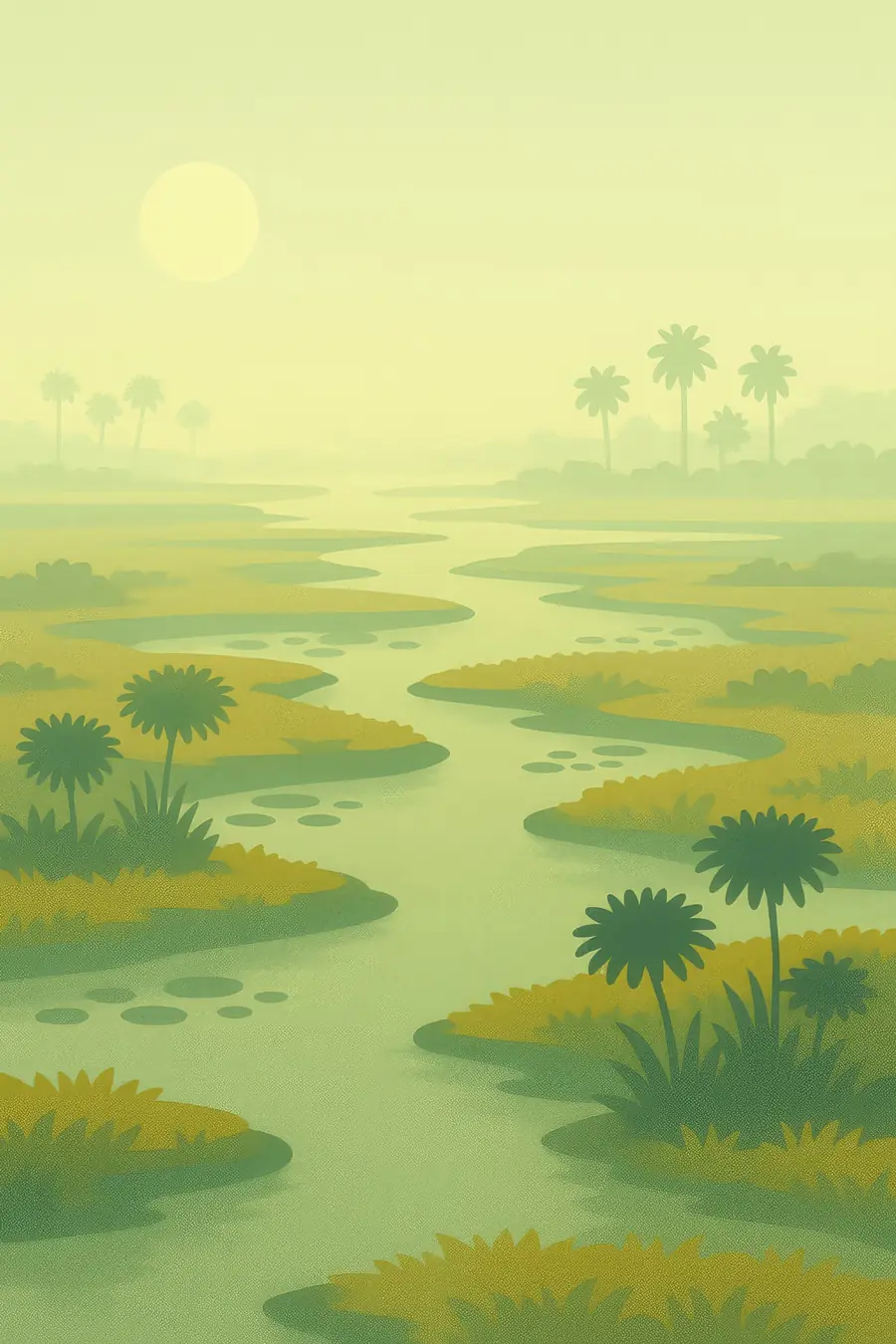
The river rises in the highlands of Angola, crosses a strip of Namibia and fans out over a flat basin in Botswana. Its water spreads through a maze of channels, lagoons, papyrus beds, reed swamps and islands with palms and fig trees. The flood arrives months after the rains in Angola, so the delta is at its fullest in the middle of the dry season, from about June to August, when the land around it is parched. Almost none of the water reaches the sea; most of it evaporates or sinks into the sand. Hippos grunt in the lagoons, frogs ring at night and fish eagles call over the water.
History
The delta sits in a shallow basin shaped by faults at the southern end of the African Rift system, which hold the river back and make it spread. Hunter-gatherer San peoples have lived here and in the surrounding Kalahari for a very long time. River peoples such as the BaYei and Hambukushu came later, fishing and farming along the channels, and in the eighteenth and nineteenth centuries the Batawana, a Tswana people, established their rule over the area. Botswana was the British protectorate of Bechuanaland until independence in 1966. In 1963 the Batawana set aside Moremi Game Reserve on their own tribal land, one of the first reserves created by an African community.
Why it matters for the living world
The delta supports some of the largest concentrations of wildlife in Africa, including elephant, buffalo, lechwe, sitatunga, lion, wild dog and both white and black rhino. IUCN notes that Botswana's elephant population, the largest in the world at about 130,000, depends on it, and that the delta is home to 24 globally threatened bird species. Its seasonal flood is a natural pulse: it spreads nutrients, renews grasslands and sustains fish breeding. The vast wetland also cools and moistens the surrounding Kalahari, and the river basin upstream, in Angola and Namibia, is essential to keeping the system alive.
People of the place
Several peoples live in and around the delta: BaYei, Hambukushu, Dxeriku, Batawana, Herero and San groups such as the Bugakhwe and ||Anikhwe. The BaYei are known for the mokoro, a dugout canoe poled through the shallow channels, now used by guides as well as fishers. Livelihoods include fishing, cattle, flood-recession farming, gathering reeds, grass and water lilies, and work in tourism. IUCN notes that local communities' stewardship over millennia is part of what makes the delta valuable. Community trusts hold concessions in some areas and earn income from tourism, though many residents say they see too little of the benefit.
What it faces
The main risks come from upstream. Plans for dams, irrigation and water abstraction in Angola and Namibia could reduce the flood that the delta depends on. Since 2020 the Canadian company ReconAfrica has explored for oil and gas in the Kavango basin in Namibia, raising concern about water pollution and disturbance to wildlife and communities. Climate change is expected to make floods more variable. Fire, fencing for livestock disease control and human-elephant conflict are other pressures. Botswana, Angola and Namibia coordinate through the Permanent Okavango River Basin Water Commission, and conservation groups, scientists and community leaders monitor and campaign on drilling and water use.
Sources
- Iconic Okavango Delta becomes 1,000th World Heritage site (IUCN)
- Okavango Delta named UNESCO World Heritage Site (National Geographic)
- A big oil project in Africa threatens the fragile Okavango region (Yale Environment 360)
- They ripped through a protected wilderness to find oil (National Geographic)
Written for Regenerative Voices from the sources above. Spotted something wrong? Tell us.