
The place
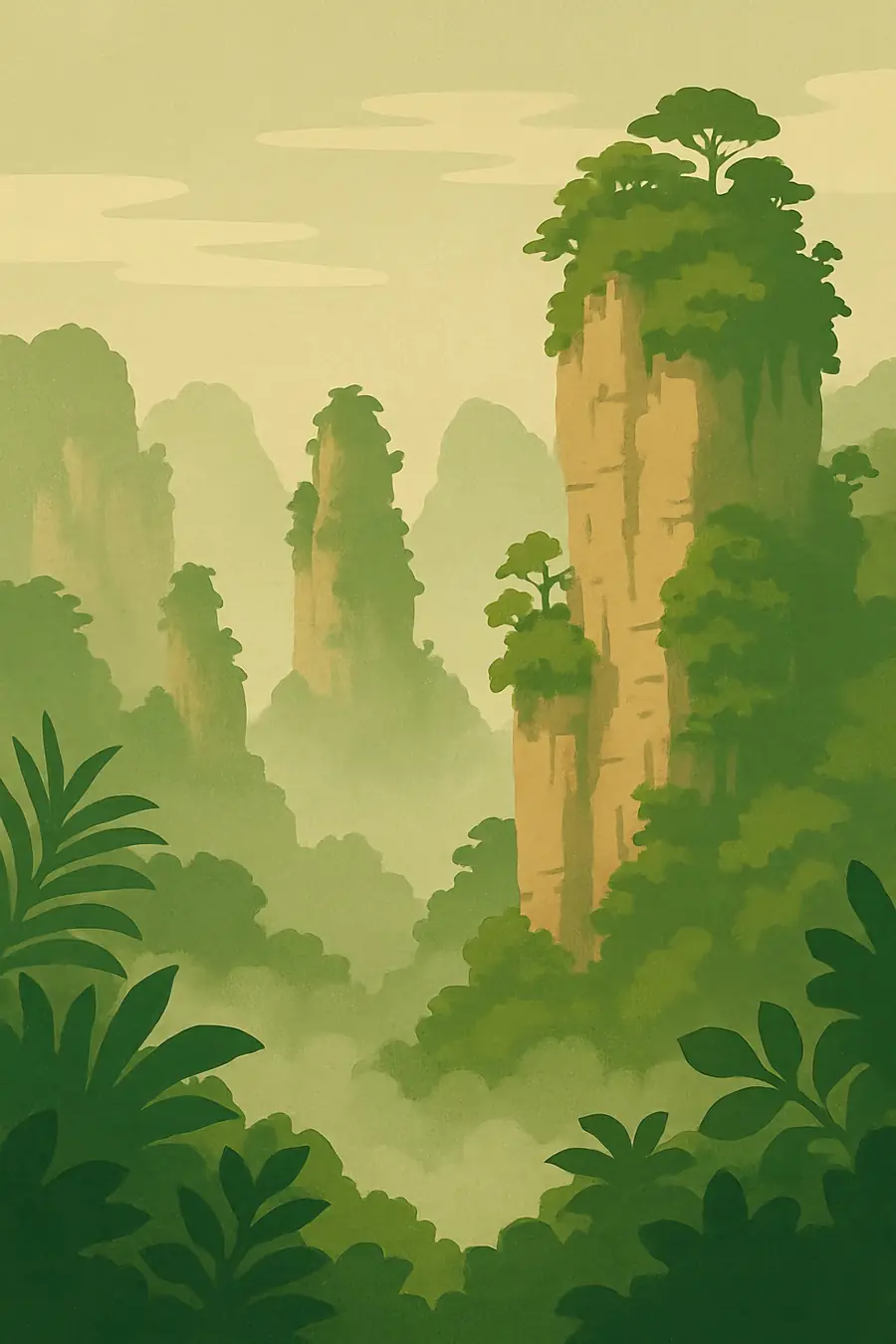
The park is a forested valley system about 48 square kilometres in size, where sandstone pillars rise straight from the trees along both sides of Golden Whip Stream. Trails follow the clear stream past pools and rocks, while stairways and viewpoints climb to plateaus such as Huangshi Village and Yuanjiajie, where the pillars can be seen from above. One of them, formerly called the Southern Sky Column, was renamed Avatar Hallelujah Mountain in 2010 after the film. The air is cool and humid, and clouds often fill the valleys. Mornings are quiet with birdsong and the sound of water; later in the day voices and loudspeakers echo off the rock.
History
The park takes its name from the Zhangjiajie area, traditionally linked to the Zhang family; local legend connects it to Zhang Liang, an adviser to the first Han emperor. Before the park, the area was a state forest farm set up in 1958, where workers planted and cut timber. In the late 1970s artists and officials drew attention to its scenery, and in 1982 it became China's first national forest park, a new model that combined forest protection with recreation. The town of Dayong nearby was renamed Zhangjiajie in 1994 to reflect the park's fame, and in 1992 the park became part of the Wulingyuan World Heritage Site.
Why it matters for the living world
The park's forest is a mix of natural subtropical broadleaf forest and older plantations of fir and pine from its timber years, and it has been recovering since logging ended. It protects steep slopes from erosion and keeps the water of Golden Whip Stream clean, a stream that runs through the park for several kilometres. Rhesus macaques live near the trails, and the forest supports many birds, insects and plants, including rare trees. The park was an early test in China of whether a forest could earn more standing than felled, and its recovery shows how former timber land can return to near-natural forest.
People of the place
The people of the park and the city of Zhangjiajie are largely Tujia, with Bai, Miao and Han communities as well. When the park opened, some former forest workers and nearby villagers became its first guides, porters and inn keepers. Today many local people work in the park as cleaners, guards, sedan-chair carriers, photographers, vendors and performers of Tujia songs and dances. Some families once lived and ran guesthouses inside the park, but most were moved out to reduce building in the core area. The park's success has made tourism the base of the city economy, which brings jobs but also dependence on visitor numbers.
What it faces
The park receives very large numbers of visitors, especially in holiday weeks, which strains trails, water supply and waste systems. In the 1990s hotels and shops inside the park polluted Golden Whip Stream, and many were later removed. New cable cars, elevators and viewing platforms change the landscape and invite more crowds. Monkeys fed by visitors become aggressive and dependent. Heavy rain causes landslides on trails. Park authorities now use shuttle buses, limit building, treat sewage and monitor the stream, and there are calls to cap visitor numbers and share income more fairly with local residents.
Sources
- Zhangjiajie National Forest Park (Wikipedia)
- Conservation of Zhangjiajie National Forest in China: protection or exploitation (UBC Wiki, FRST370)
- Zhangjiajie Facts: 10 Things Travelers Ought to Know (China Highlights)
- Zhangjiajie National Forest Park (Wikivoyage)
Written for Regenerative Voices from the sources above. Spotted something wrong? Tell us.