
The place
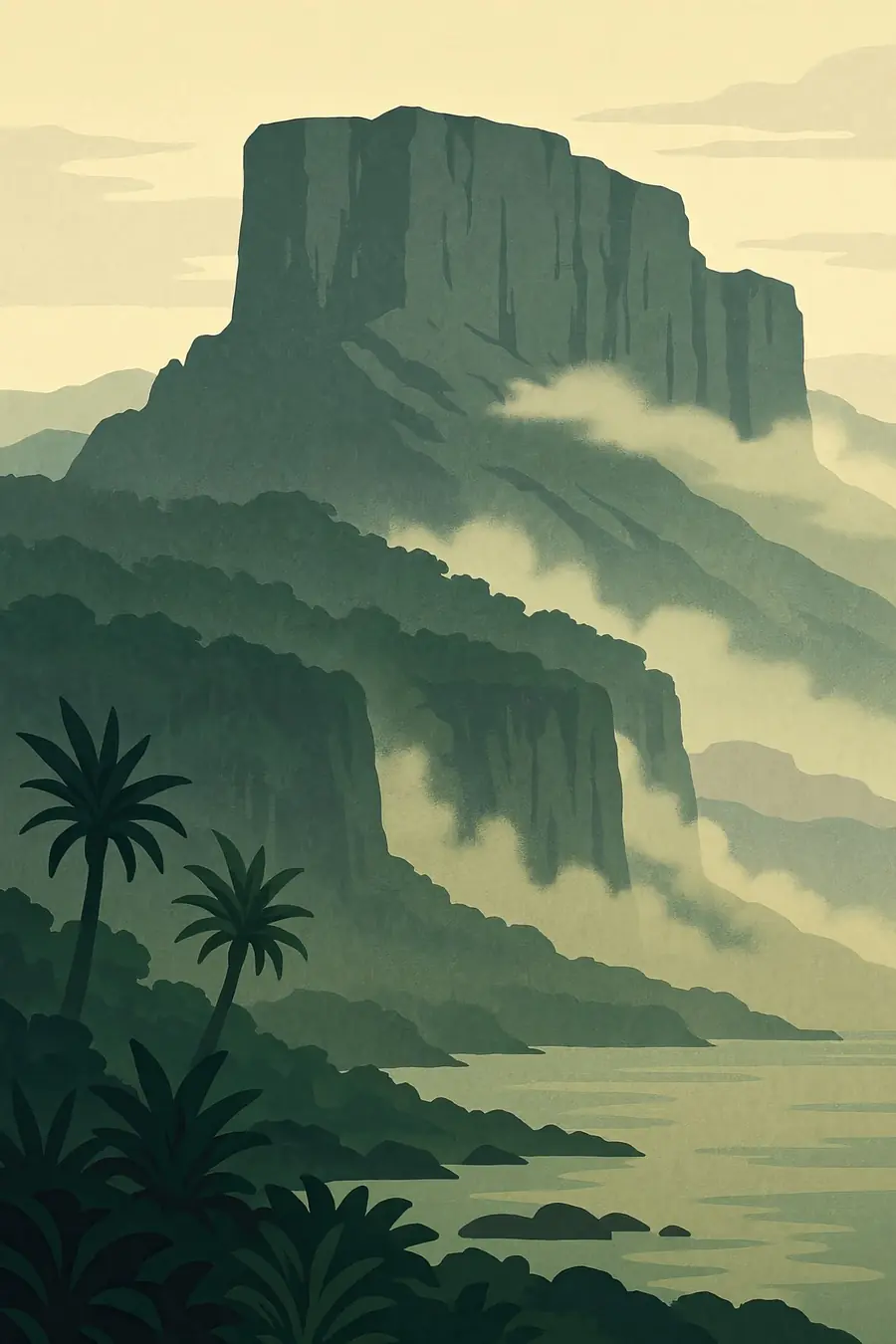
Roraima rises from the rolling savanna of the Gran Sabana as a wall of sheer cliffs about 400 metres high, crowned by a summit plateau. The top is a strange world of black, wind-carved rock, quartz crystals, pools, pink sand and small pockets of plants. Clouds wrap the summit most days, and rain falls nearly every day, so waterfalls pour off the cliffs into three countries and three river systems: the Amazon, the Orinoco and the Essequibo. It is cool and damp on top, with fog that comes and goes in minutes. A single route, a natural ramp on the Venezuelan side, lets walkers reach the summit without climbing gear.
History
The sandstone of Roraima formed from sediments laid down about 1.8 billion years ago, among the oldest rock formations on Earth. Erosion over many millions of years removed the surrounding layers, leaving tepuis standing as islands. For the Pemon, Roraima is the stump of a great tree that held all the world's fruit until the hero Makunaima cut it down, releasing floods. The Pemon word tepui is often translated as house of the gods. Europeans first reached the summit in 1884, led by Everard im Thurn and Harry Perkins. Accounts of the expedition helped inspire Arthur Conan Doyle's novel The Lost World. Venezuela created Canaima National Park in 1962.
Why it matters for the living world
Tepui summits are like islands in the sky, isolated from the lowlands for millions of years. About a third of the plants on tepui summits are found nowhere else, according to WWF, including carnivorous pitcher plants, sundews and bladderworts, as well as many orchids and bromeliads. Roraima is home to the tiny Roraima black frog, which walks rather than hops. A 2012 study estimated that summit ecosystems may have been isolated for tens of millions of years, though DNA from tree frogs suggests some exchange between tepuis more recently. The surrounding savannas and forests of the Guiana Shield store carbon and feed several of the continent's major rivers.
People of the place
The Pemon, a Carib-speaking people, live in the Gran Sabana around Roraima and treat the tepuis as sacred, home to spirits called mawari. Villages such as Paraitepuy and San Francisco de Yuruaní are the starting points for treks, and Pemon guides and porters lead most visitors to the summit. In Brazil, the Ingarikó live near the mountain, and their land overlaps Monte Roraima National Park. In Guyana, the Akawaio and Patamona live in the surrounding highlands. Pemon communities in Venezuela have their own Indigenous guard and have repeatedly asserted control over their territory, including in conflicts with the military over mining and tourism.
What it faces
The Venezuelan side faces pressure from gold mining, much of it illegal, spreading in the south of Bolívar State and parts of Canaima National Park, bringing mercury pollution, deforestation and armed groups. Fires set to manage savanna can spread into forest. Tourism on Roraima brings waste and erosion; visitors must carry out all their waste, and taking crystals is banned. Climate change could shift the cloud and rainfall patterns on which summit plants depend, and species with nowhere higher to go are especially at risk. IUCN rated Canaima's conservation outlook as of significant concern in 2017, citing weak protection and management. Pemon communities play a central role in guarding the area.
Sources
- Mount Roraima: the 'lost world' isolated for millions of years (Live Science)
- Canaima National Park (Wikipedia)
- Monte Roraima National Park (International Parks)
Written for Regenerative Voices from the sources above. Spotted something wrong? Tell us.