
The place
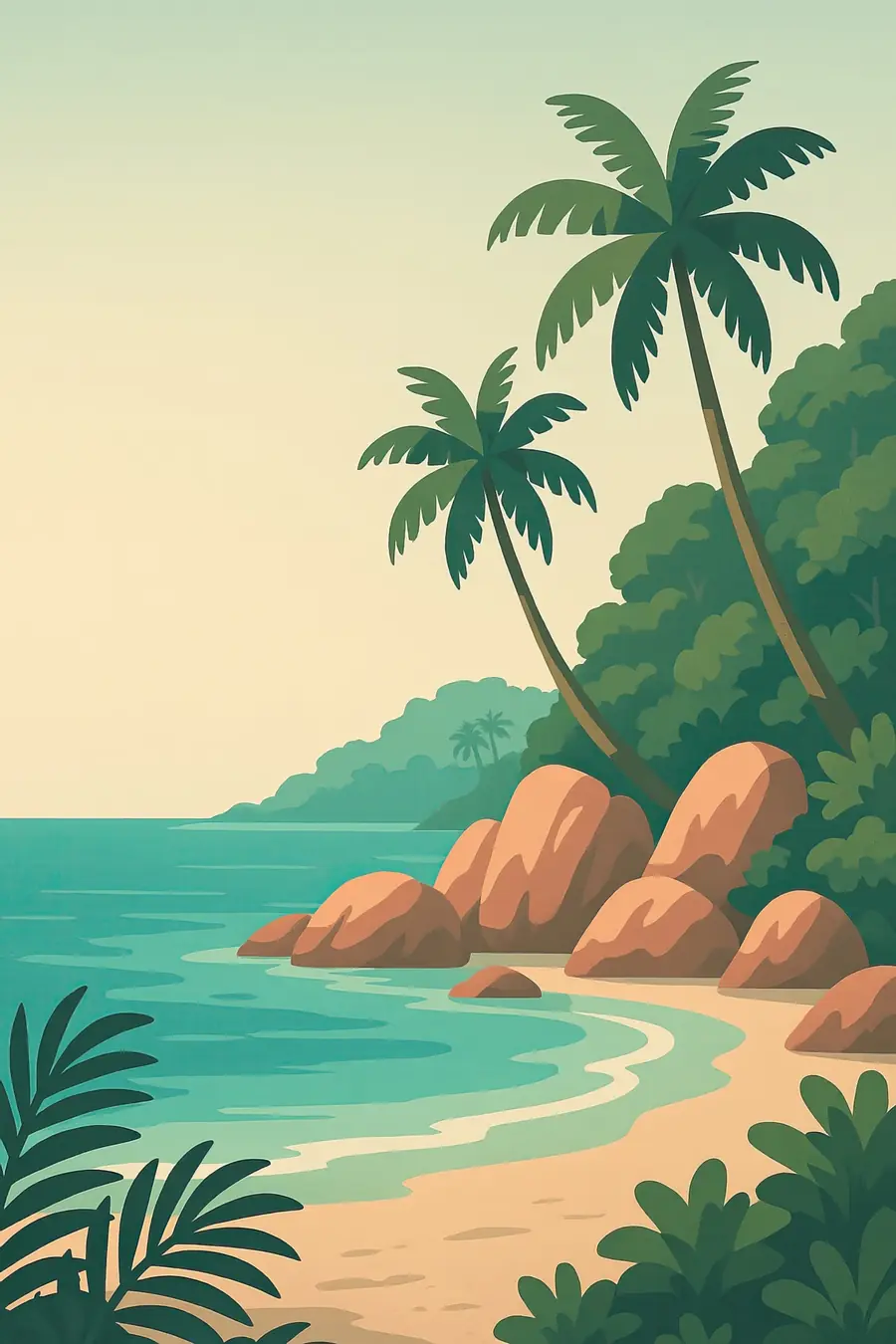
The inner islands, among them Mahé, Praslin and La Digue, are made of granite, with steep forested hills, smooth boulders polished by rain and sea, and white beaches. They are among the very few mid-ocean islands formed of continental rock. The outer islands are low coral islands and atolls, flat, sandy and scattered across a wide area of ocean. The climate is warm and humid all year, shaped by two monsoon seasons. In the forests you hear the calls of endemic birds and the patter of rain on large palm leaves; on the shore you hear waves on the reef and the wind in casuarina trees.
History
The granite islands are pieces of the old continent Gondwana. They were left behind as India broke away first from Madagascar and then, around 65 million years ago, from the Seychelles block itself. The islands were uninhabited until 1770, when French settlers arrived with enslaved Africans and Indians to plant spices and coconuts. Britain took control in the early nineteenth century, and after the abolition of slavery many freed Africans were brought to the islands. Seychelles became independent in 1976. Much of the original forest was cut for timber and plantations. Aldabra was saved from plans for a military airbase in the 1960s and was listed by UNESCO in 1982.
Why it matters for the living world
Seychelles has many plants and animals found nowhere else, because the islands have been isolated for so long. The Vallée de Mai on Praslin protects a palm forest with the coco de mer, whose seed is the largest in the plant kingdom, and the rare black parrot. Aldabra, one of the largest coral atolls in the world, is home to around 100,000 giant tortoises, the white-throated rail, and large colonies of seabirds and nesting green turtles. The surrounding ocean has coral reefs, seagrass beds and fish. In 2020 Seychelles completed the protection of 30 percent of its marine territory, partly financed through a debt-for-nature agreement.
People of the place
Seychellois are a Creole people with African, European, Indian, Chinese and Malagasy roots. Most live on Mahé and speak Seychellois Creole, Kreol Seselwa, as well as English and French. Fishing and tourism are the main sources of income, and many families also grow fruit and vegetables. Local knowledge of the sea, fishing grounds and medicinal plants is part of everyday culture. The Seychelles Islands Foundation, a public trust, manages Aldabra and the Vallée de Mai, and many Seychellois work as rangers, scientists and guides on the islands. Community groups and NGOs are active in turtle monitoring, island restoration and reef protection.
What it faces
Coral bleaching from warming seas, especially in 1998 and 2016, killed much of the coral on many reefs. Sea-level rise threatens low coral islands and the coastal land where most people live. Invasive species such as rats, cats and introduced plants have devastated native wildlife on many islands. Tourism and development put pressure on coasts and water supply. Overfishing affects some stocks. In response, Seychelles has eradicated rats and cats from several islands and reintroduced native birds, expanded marine protected areas, and runs coral restoration projects. Aldabra is protected with strict access rules to keep it as close to natural as possible.
Sources
- Welcome to Aldabra (Seychelles Islands Foundation)
- Coral atoll where giant tortoises outnumber man 10,000:1 (Phys.org)
- Vallée de Mai (WorldHeritageSite.org)
- Seychelles' Vallée de Mai celebrates 40 years as UNESCO World Heritage Site (ATC News)
Written for Regenerative Voices from the sources above. Spotted something wrong? Tell us.