
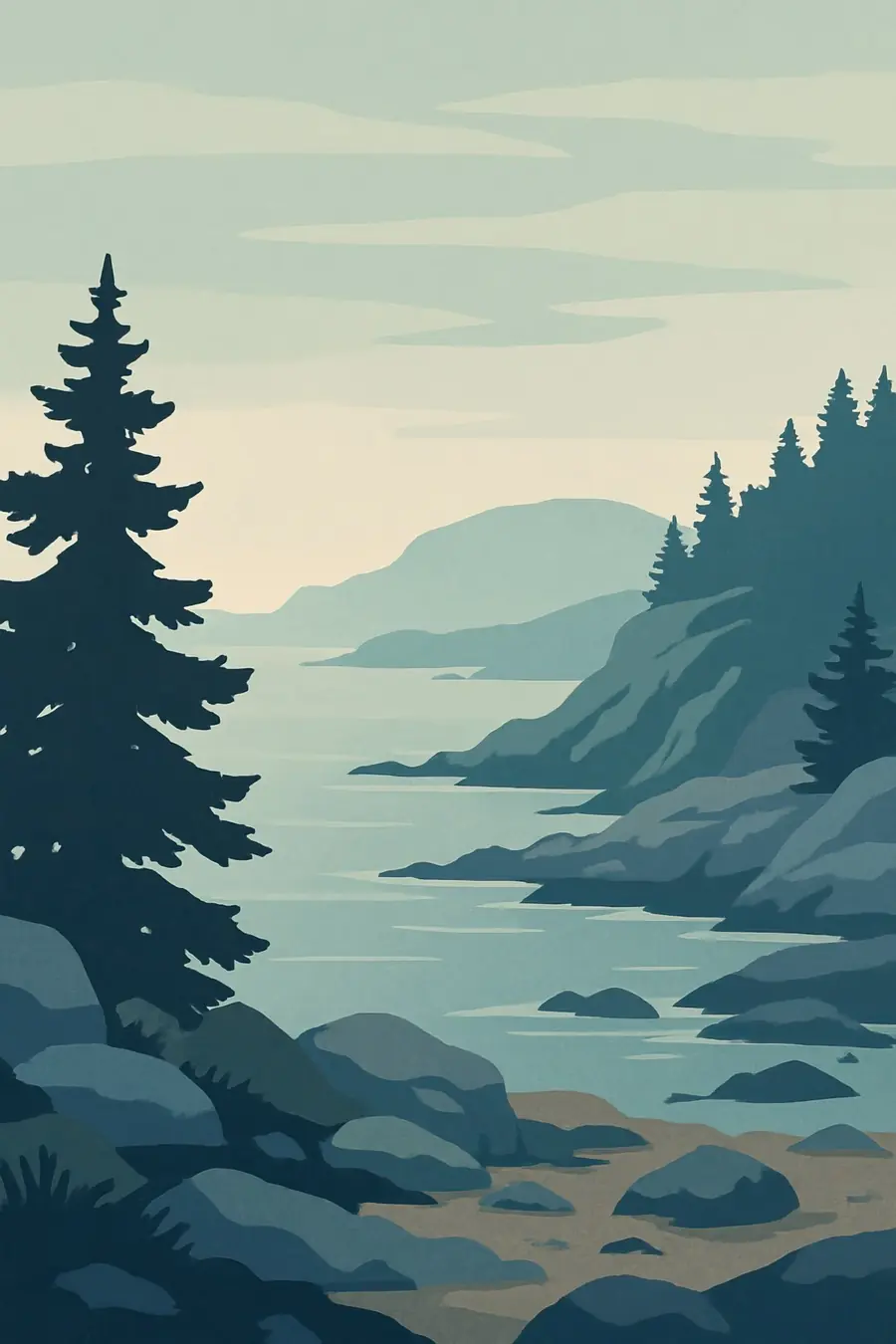
The place
Pink granite mountains rise straight from the sea here, rounded and scraped by ice sheets that withdrew some fifteen thousand years ago. Cadillac Mountain is the highest point on the island, and Somes Sound cuts deep into its middle like a narrow fjord. Spruce and fir cover much of the ground, with birch, maple and aspen where old fires burned. The coast is a mix of cobble beaches, tide pools and cliffs where Atlantic swells boom into narrow chasms. Summers are cool and foggy, winters long and snowy. You hear gulls, bell buoys, lobster boats leaving harbour at dawn and, in the woods, the thin songs of warblers.
History
The Wabanaki peoples have used this island for thousands of years, travelling by canoe to hunt, fish, gather shellfish and meet. Their name for it, Pemetic, is usually translated as "range of mountains". In 1604 Samuel de Champlain sailed past and called it the island of bare mountains, and for the next century and a half the coast was contested between France and Britain, with the Wabanaki caught between them. Settlers farmed, fished and cut timber here in the 1800s. Painters and wealthy summer visitors followed, and some of them, led by George Dorr and Charles Eliot, bought land to protect it. It became a national monument in 1916 and took the name Acadia in 1929.
Why it matters for the living world
Acadia sits where northern boreal forest meets the temperate forests of the south, so species from both meet on one island. Its intertidal zone is among the richest on the eastern seaboard, with periwinkles, barnacles, rockweed, sea stars and crabs. Peregrine falcons, once gone from the eastern United States, nest again on the cliffs after a reintroduction effort in the 1980s. The park lies on a major Atlantic flyway, and songbirds, raptors and seabirds pass through each spring and autumn. Its wetlands, bogs and lakes hold freshwater for the island, and long-term monitoring here tracks how a warming Gulf of Maine affects coastal life.
People of the place
The Wabanaki Confederacy, made up of the Penobscot, Passamaquoddy, Maliseet and Mi'kmaq nations, regards the island as part of its homeland. Wabanaki families sold baskets and crafts to summer visitors at Bar Harbor in the 1800s and kept returning long after settlers claimed the land. Today the park works with the Wabanaki nations on research and stewardship, including a study on sustainable sweetgrass gathering, a plant important for basketmaking. The Abbe Museum in Bar Harbor shares Wabanaki history in partnership with tribal advisers. Island towns such as Bar Harbor, Southwest Harbor and Bass Harbor live from lobstering, boatbuilding and tourism, and many families have deep roots in the fishing life.
What it faces
Visitor numbers have grown to several million a year, bringing traffic and crowding to a small island. The park now uses a timed-entry reservation system for the road up Cadillac Mountain during the busy season. The Gulf of Maine is warming faster than most of the world's oceans, which changes fish and lobster populations and stresses intertidal life. Rising seas and stronger storms erode shorelines and damage roads and historic structures. Ticks and invasive forest pests are spreading north with warmer winters. The park is using long-term monitoring, visitor management, invasive plant removal and partnerships with researchers and the Wabanaki nations to adapt.
Sources
- Wabanaki Nations - Acadia National Park (NPS)
- Acadia History Brief (NPS)
- Asticou's Island Domain: Wabanaki Peoples at Mount Desert Island 1500-2000, Vol. 1 (NPS)
- The Wabanaki and Acadia (Down East)
Written for Regenerative Voices from the sources above. Spotted something wrong? Tell us.