
The place
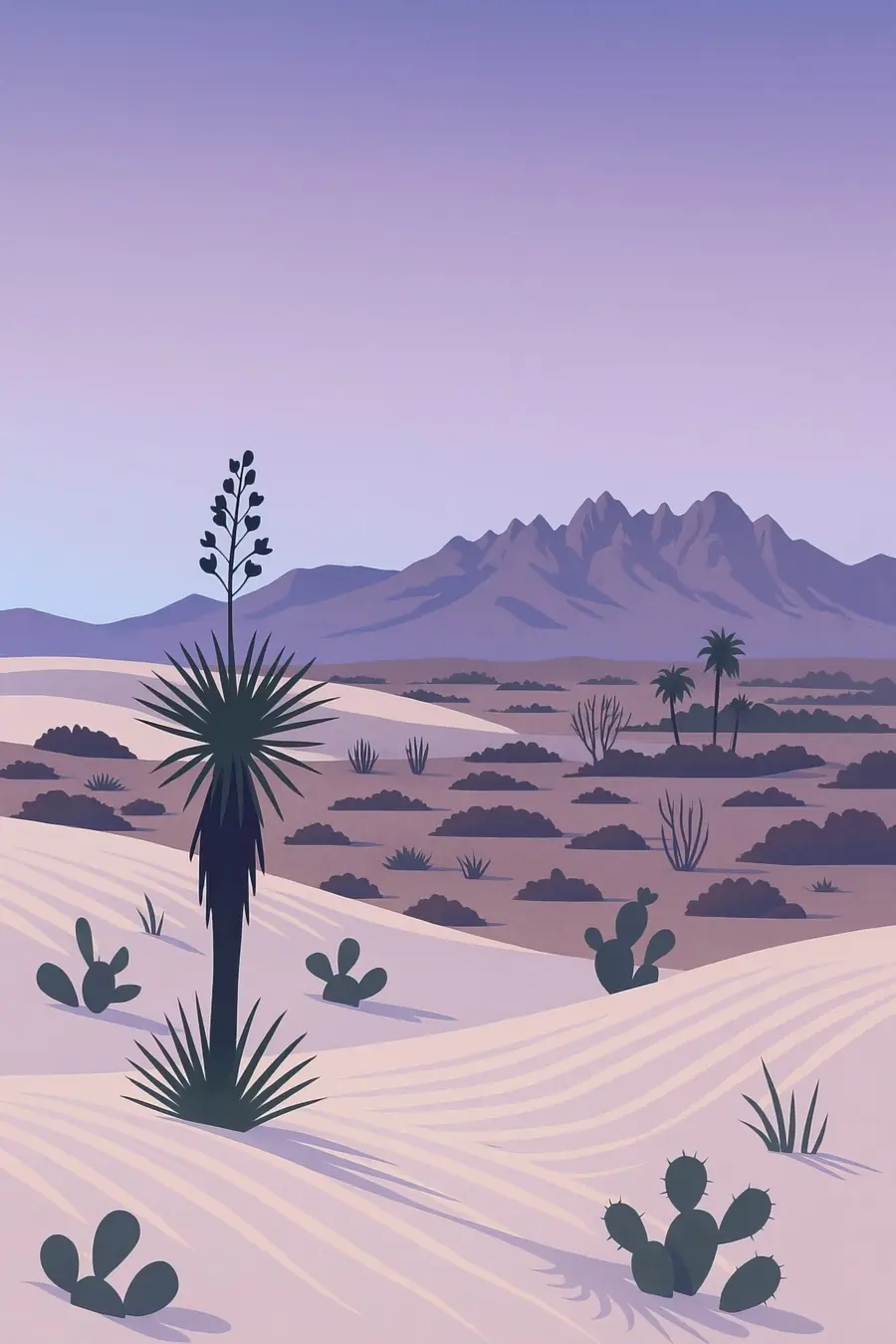
White Sands is the world's largest gypsum dunefield, covering about 275 square miles of the Tularosa Basin. The gypsum comes from ancient lake beds, and wind piles the fine white grains into dunes that move slowly across the basin floor. The sand stays cool underfoot even in summer heat. To the southwest the Organ Mountains rise steeply above Las Cruces in a row of jagged granite and volcanic spires that look like organ pipes. Between them lie creosote flats, grasslands and dry canyons. The climate is hot and dry, with summer monsoon storms and cold winter nights. You hear wind over the dunes, the hum of insects and, from the military range nearby, the distant roar of jets.
History
The basin once held a large lake, Lake Otero, during the last ice age. In 2021 scientists reported human footprints in the old lake shore sediments at White Sands dated to around 21,000 to 23,000 years ago, among the oldest evidence of people in the Americas. Later peoples hunted, gathered and farmed in the region. The Mescalero Apache made the mountains and basin part of their homeland, and Piro, Manso and other peoples lived along the Rio Grande. The Spanish Camino Real passed nearby. After the United States took the area, ranching and mining followed. In 1945 the first atomic bomb was tested at Trinity, at the north end of the basin. White Sands became a national monument in 1933 and a national park in 2019.
Why it matters for the living world
Some animals at White Sands have evolved pale colouring that blends with the white sand, including lizards, mice and insects, making the dunes a living study of evolution. The White Sands pupfish lives only in a few springs and streams in the basin. The Organ Mountains hold rare plants and wildlife, with oak and pine on the higher slopes, and mountain lions, mule deer and golden eagles in the canyons. The monument also protects desert grasslands that support pronghorn, hawks and many grassland birds. Both areas are part of the Chihuahuan Desert, one of the most biologically rich deserts in the world, and record long histories of climate change.
People of the place
The Mescalero Apache Tribe, whose reservation lies in the Sacramento Mountains east of the basin, regards the area as part of its traditional homeland. The Piro-Manso-Tiwa Tribe of San Juan de Guadalupe in Las Cruces and other Pueblo and Hispanic communities also have long ties to the land. Many people in Las Cruces and nearby towns of Hispanic and Indigenous heritage pushed for the national monument, which was created in 2014 after years of local campaigning. Ranchers still graze cattle in parts of the monument. White Sands Missile Range and Holloman Air Force Base surround much of the national park and are major employers in the region.
What it faces
Groundwater pumping for cities and farms is lowering water tables in the Tularosa Basin, which may affect the moist base that holds the dunes together and the springs where pupfish live. Climate change is bringing hotter, drier conditions and stronger droughts. Rapid growth in Las Cruces raises pressure on the edges of the Organ Mountains. Off-road vehicles, trash and vandalism damage fragile desert soils and archaeological sites. The ancient footprints at White Sands are eroding as wind uncovers them, so researchers are racing to record them. The parks work with tribes, scientists and the military on monitoring, and the Bureau of Land Management is preparing a long-term management plan for the monument.
Sources
- White Sands National Park History (NPS)
- USGS Fact Sheet 2025-3046 (U.S. Geological Survey)
- White Sands Footprints (EarthDate)
- Secretary Jewell Joins Community to Celebrate Organ Mountains-Desert Peaks National Monument Designation (U.S. Department of the Interior)
- Organ Mountains-Desert Peaks National Monument (Conservation Lands Foundation)
Written for Regenerative Voices from the sources above. Spotted something wrong? Tell us.