
The place
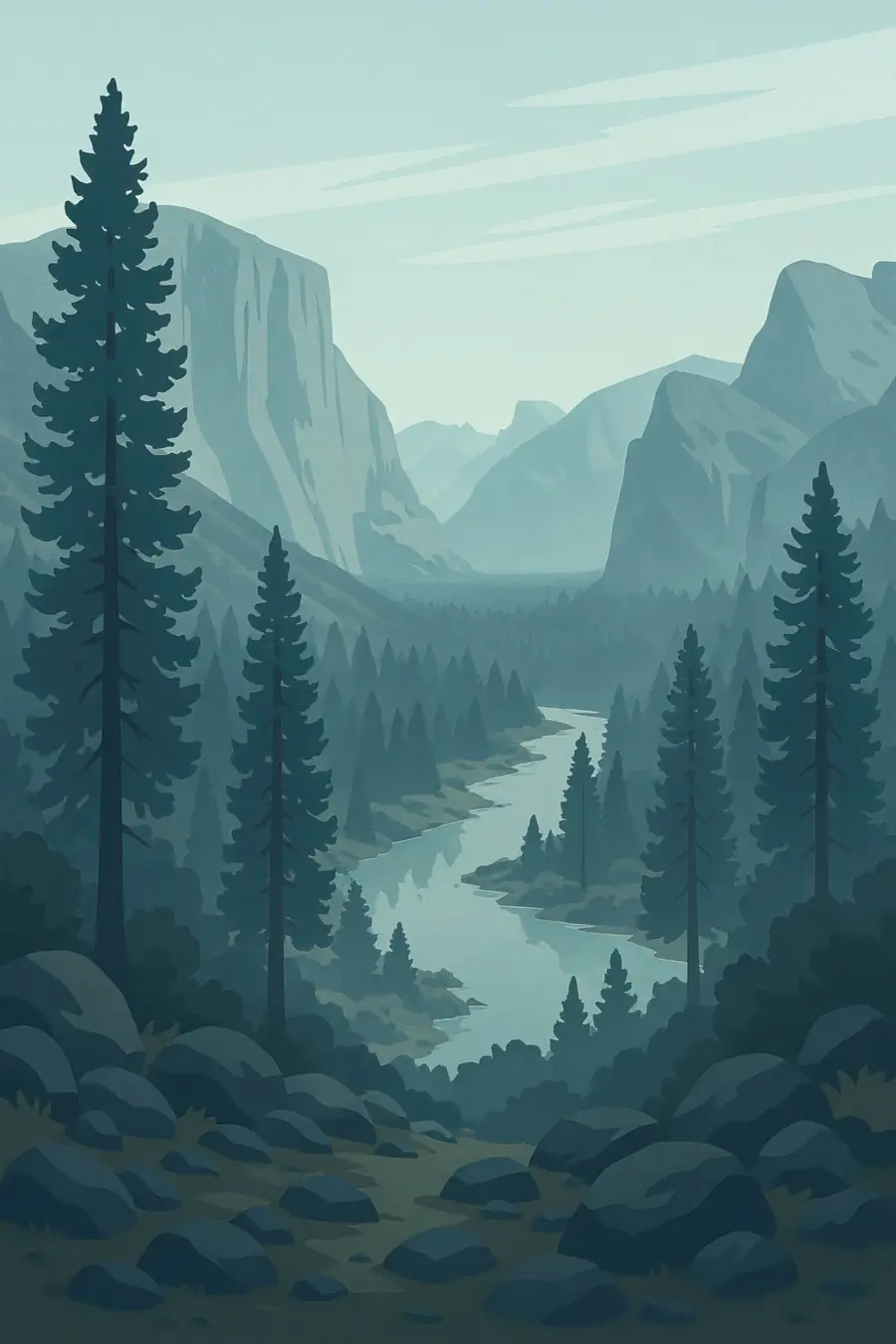
Yosemite is built of granite that formed deep underground as molten rock cooled, then rose as the Sierra Nevada lifted and tilted. Glaciers later carved Yosemite Valley into a deep U-shaped trough, leaving sheer walls such as El Capitan and Half Dome. Waterfalls pour over the rim, loudest in late spring when snow melts. Above the valley lie high granite domes, meadows, lakes and peaks over 3,900 metres. Forests of pine, fir and cedar cover the mid slopes, and giant sequoias grow in a few groves. Summers are dry and warm, winters snowy in the high country. You hear falling water, Steller's jays, wind in the pines and, on quiet nights, rockfall.
History
The Ahwahneechee, a Southern Sierra Miwok people, lived in Yosemite Valley, which they called Ahwahnee, for many generations, and Mono Lake Paiute and other neighbours traded and intermarried with them. They burned the valley floor to keep open meadows and oak groves for acorns. During the Gold Rush, in 1851, the Mariposa Battalion, a state-backed militia, entered the valley to force the people onto a reservation. Chief Tenaya's people were driven out and many were killed. Tourists and settlers soon followed. In 1864 President Lincoln signed the Yosemite Grant, an early act of land protection by the federal government. John Muir campaigned for a national park, created in 1890.
Why it matters for the living world
Yosemite spans a wide range of elevations, from oak woodland in the foothills to alpine tundra, and holds a great variety of plants and animals. Its giant sequoia groves, including the Mariposa Grove, contain some of the largest trees on Earth. Black bears, mule deer, Sierra Nevada bighorn sheep and great grey owls live here, along with the threatened Yosemite toad and Sierra Nevada yellow-legged frog. Its rivers, the Tuolumne and the Merced, supply water to farms and cities, and the Hetch Hetchy reservoir inside the park provides water to San Francisco. Its meadows store water and carbon and support wildlife in the dry summer months.
People of the place
Seven tribes have traditional ties to Yosemite, including the Southern Sierra Miwuk Nation, the Tuolumne Band of Me-Wuk, the Mono Lake Kutzadika'a, the Bishop Paiute, the Bridgeport Indian Colony, the North Fork Rancheria of Mono Indians and the Picayune Rancheria of Chukchansi. Native families lived and worked in the valley well into the twentieth century, until the last Indian village there was removed in 1969. Today tribes work with the park on cultural sites, traditional gathering and a reconstructed village. Tribes and the park are bringing back cultural burning to restore meadows and oaks. Gateway communities such as Mariposa, El Portal and Groveland depend on tourism.
What it faces
Wildfire has become larger and more intense after a century of fire suppression and in a warming, drier climate. Fires such as the Rim Fire in 2013 burned large areas, and the Washburn Fire in 2022 threatened the Mariposa Grove. Drought and bark beetles have killed millions of trees across the Sierra Nevada. Snowpack is shrinking, which reduces summer water for rivers and meadows. Crowding is severe in peak season, so the park has used timed-entry reservations. Air pollution from the Central Valley also drifts into the park. The park uses prescribed burns, works with tribes on cultural burning and restores meadows to help them hold water.
Sources
- Their Lifeways - Yosemite (NPS)
- Five Views: An Ethnic Historic Site Survey for California - American Indians (NPS)
- History of the Yosemite area (Wikipedia)
- Mariposa War (Wikipedia)
Written for Regenerative Voices from the sources above. Spotted something wrong? Tell us.